Why core spun yarn keeps showing up in fabric development
When sourcing teams ask about core spun yarn, they are usually trying to solve a familiar problem: how to get a yarn that feels wearable but still holds up in production and in use. That balance matters in knitwear, woven fabrics, socks, trims, and other categories where a soft hand alone is not enough. A yarn that looks good on the cone but behaves badly in knitting or weaving can create waste fast, and no mill likes discovering that after the first trial run.
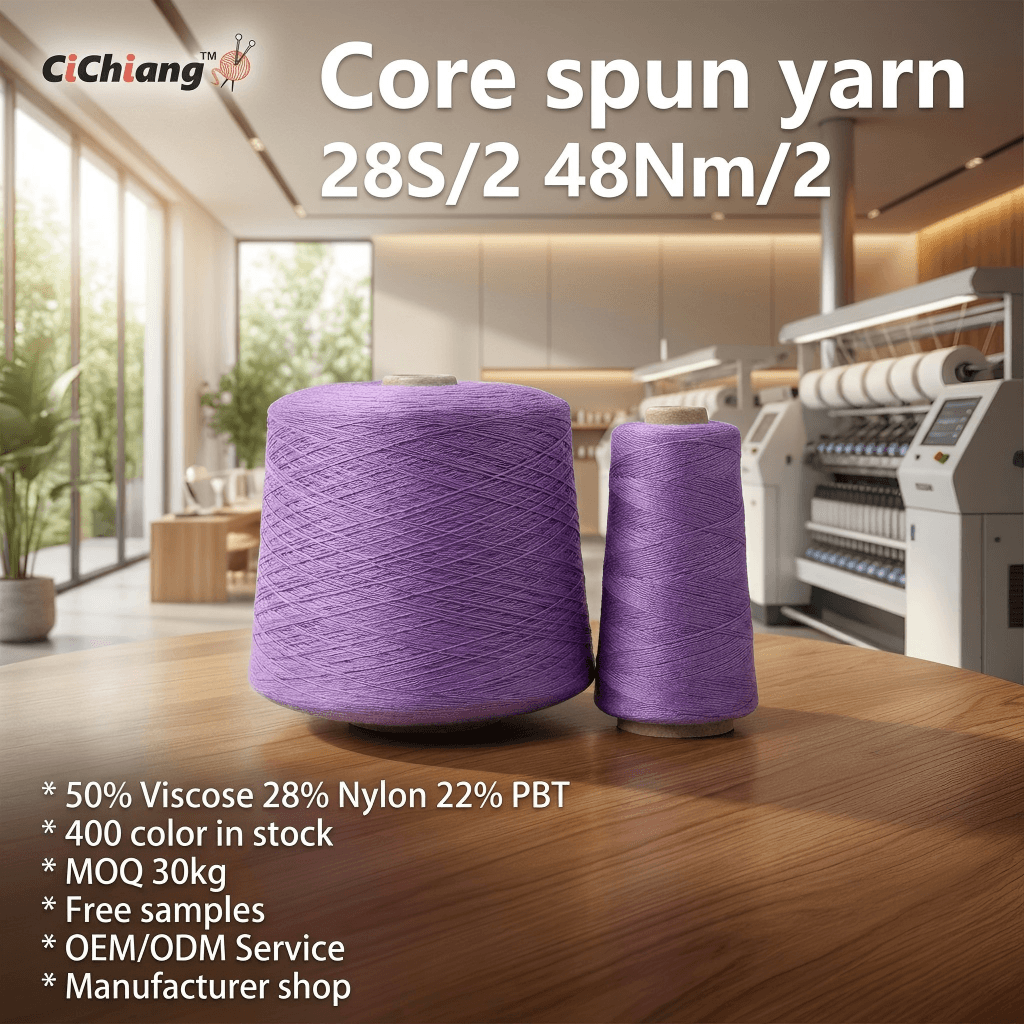
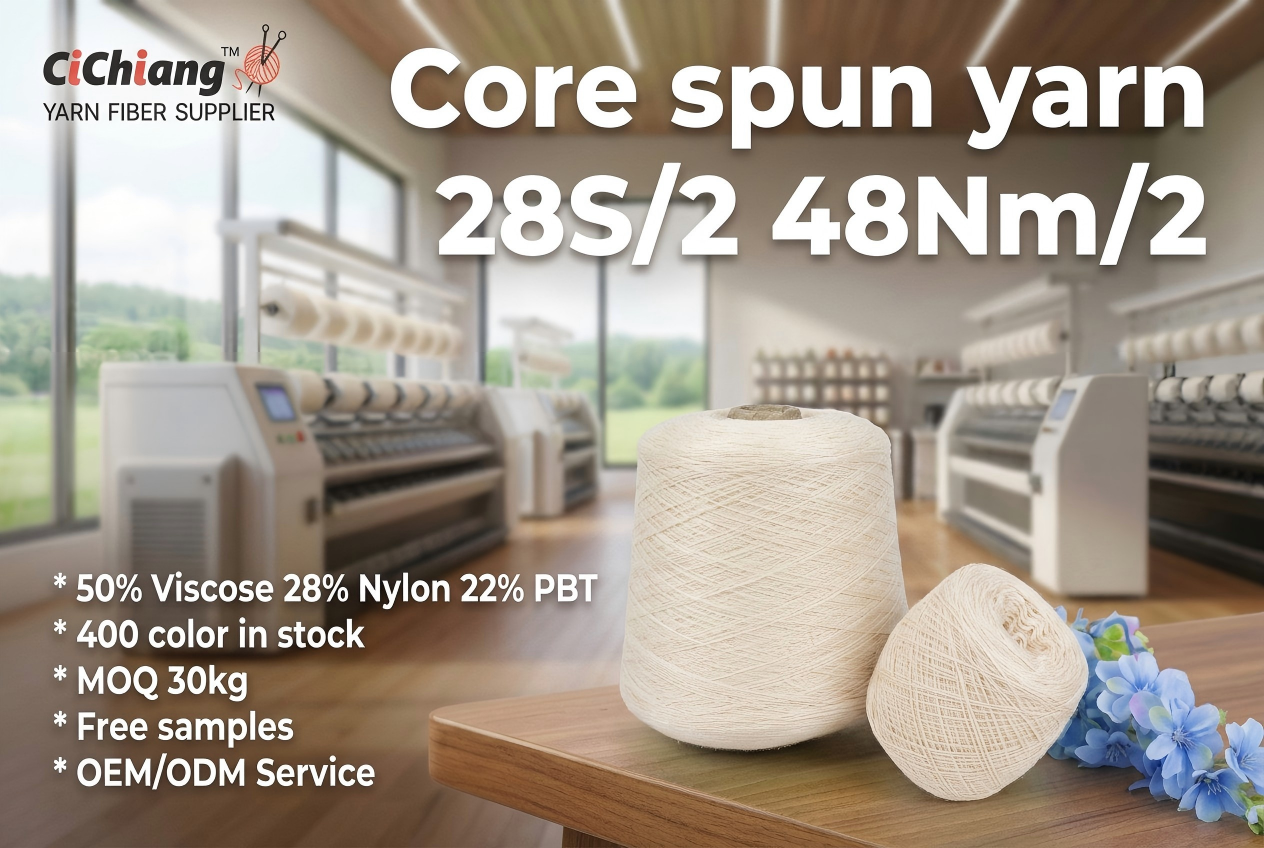
In practical terms, core spun construction is attractive because it can combine different fiber traits in one yarn. The supplied material notes point to a blend of 50% viscose, 28% nylon, and 22% PBT, which suggests a yarn designed to balance softness, strength, and some degree of recovery. The visible product also shows a fine, even, creamy or bright-colored yarn wound neatly on cones and sample balls, with counts marked as 28S/2 and 48Nm/2. For buyers, that is the kind of basic specification that helps move a project from sampling to quoting.
What buyers usually want to know first
Before getting into styling or fashion use, sourcing managers usually want the short version: can this yarn run, can it be dyed or matched consistently, and is the supplier set up for repeat orders? In the supplied information, the offering includes 400 colors in stock, MOQ 30 kg, free samples, and OEM/ODM service. Those are useful signals for development work, especially for smaller runs or fast-moving product calendars.
That said, a buyer should still ask for the usual technical sheet and test data before committing. The composition and yarn count are helpful, but they do not tell the full story on twist balance, shrinkage, pilling, or knitting performance. Those details matter more than a neat cone photo when the yarn reaches production.
Where this type of yarn fits in production
Based on the supplied notes, this yarn is suitable for apparel knitting, fashion fabrics, socks, sweaters, trims, and woven textiles. That is a broad range, but it makes sense for a blended yarn with synthetic support and a softer viscose component. In many mills, that kind of profile is chosen when designers want a cleaner surface than a basic utility yarn but still need dependable process behavior.
For core spun yarn for knitting, consistency in winding and count is especially important. Uneven packages can create tension problems and breakage at the machine. For core spun yarn for weaving, the concern shifts slightly toward smooth feeding and stable yarn behavior under repeated abrasion. The same cone can be acceptable for both, but the end-use requirements are not identical, and sourcing teams should not treat them as interchangeable just because the yarn looks similar on a shelf.
Reading the specification without overreading it
The visible counts, 28S/2 and 48Nm/2, indicate a two-ply yarn in both English and metric systems. That helps with cross-checking among technical teams, especially when one department thinks in Ne and another in Nm. It is a small detail, but it saves time during sampling discussions.
The fiber blend is also worth reading carefully. Viscose usually brings a softer, more textile-friendly feel. Nylon is often used to support durability. PBT is commonly associated with stretch and resilience in textile applications. Together, those components suggest a yarn aimed at a balanced performance profile rather than a purely decorative one. Still, this is where caution helps: the exact behavior depends on spinning method, twist, finishing, and end-use construction. A buyer should not assume a performance level that has not been tested.
Choosing a core spun yarn manufacturer or supplier
If you are comparing a core spun yarn manufacturer with a trading company or a broader core spun yarn supplier, the factory details matter. Ningbo Sinopec Fiber Co., Ltd., founded in 1996, specializes in nylon fiber manufacturing. The company says it has 150 employees, including 20 engineers, and a factory area of 50,000 square meters with 20,000 square meters of production space. It also reports a daily output of 100-150 tons, with production centered on PA6 and PA66 polyamide nylon fibers.
That kind of background can be relevant for buyers who need a stable manufacturing partner, especially for long-term development rather than one-off purchasing. The practical question is not just whether the supplier can sell yarn once, but whether they can support repeat order consistency across color, count, and package quality.
Common mistakes in sourcing blended yarn
One common mistake is focusing only on color. Bright lemon yellow or creamy off-white may look convincing in a photo, but mill performance is another matter. Another is assuming all “core spun” constructions behave the same. They do not. The sheath material, core content, and finishing step can change the feel and processability significantly.
A second mistake is underestimating the effect of order size and sampling policy. An MOQ of 30 kg sounds manageable, but the real question is whether that quantity is enough to test the yarn in your own machinery. For knitted garments, a small lab sample may be adequate for hand feel, yet production teams often need a larger run before approving bulk.
A practical buyer checklist
Ask for composition confirmation, yarn count, color matching details, package format, and sample length before you quote to your own customer. If the yarn is intended for core spun yarn wholesale purchasing, request consistent lot labeling and clarify whether stock colors are ready to ship or reserved for sampling. If your project needs a softer hand, confirm whether the supplier can suggest an alternative blend or a similar count with a different finish.
And if your team is comparing polyester core spun yarn or cotton core spun yarn options elsewhere, keep the end use front and center. Polyester-rich constructions often tilt toward durability and lower maintenance, while cotton-based yarns tend to answer a different brief around comfort and appearance. The right choice is usually the one that fits the garment or fabric spec, not the one that sounds best in a catalog.
What to do next
If you are developing apparel, knitwear, or woven samples, this type of yarn is worth shortlisting for lab testing. Ask the supplier for a sample, compare the hand feel against your target fabric, and run it through your actual machine settings before moving further. That small step can save a larger headache later, especially when the project deadline is already tight.
For sourcing discussions, the useful next move is simple: request the technical sheet, confirm the color availability, and verify whether the yarn’s blend and count align with your production route. The cone may look ordinary, but in textile work, ordinary-looking inputs often decide whether the final fabric behaves properly on the line.