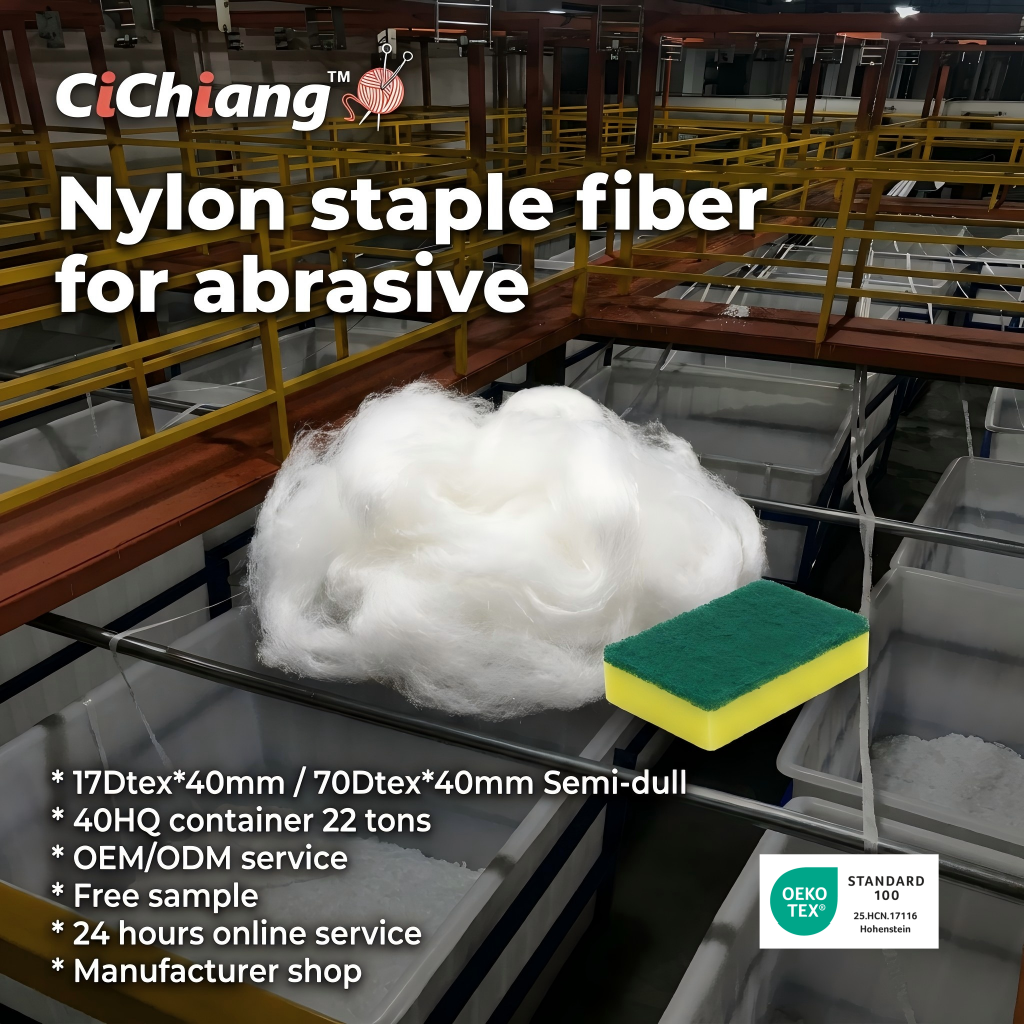
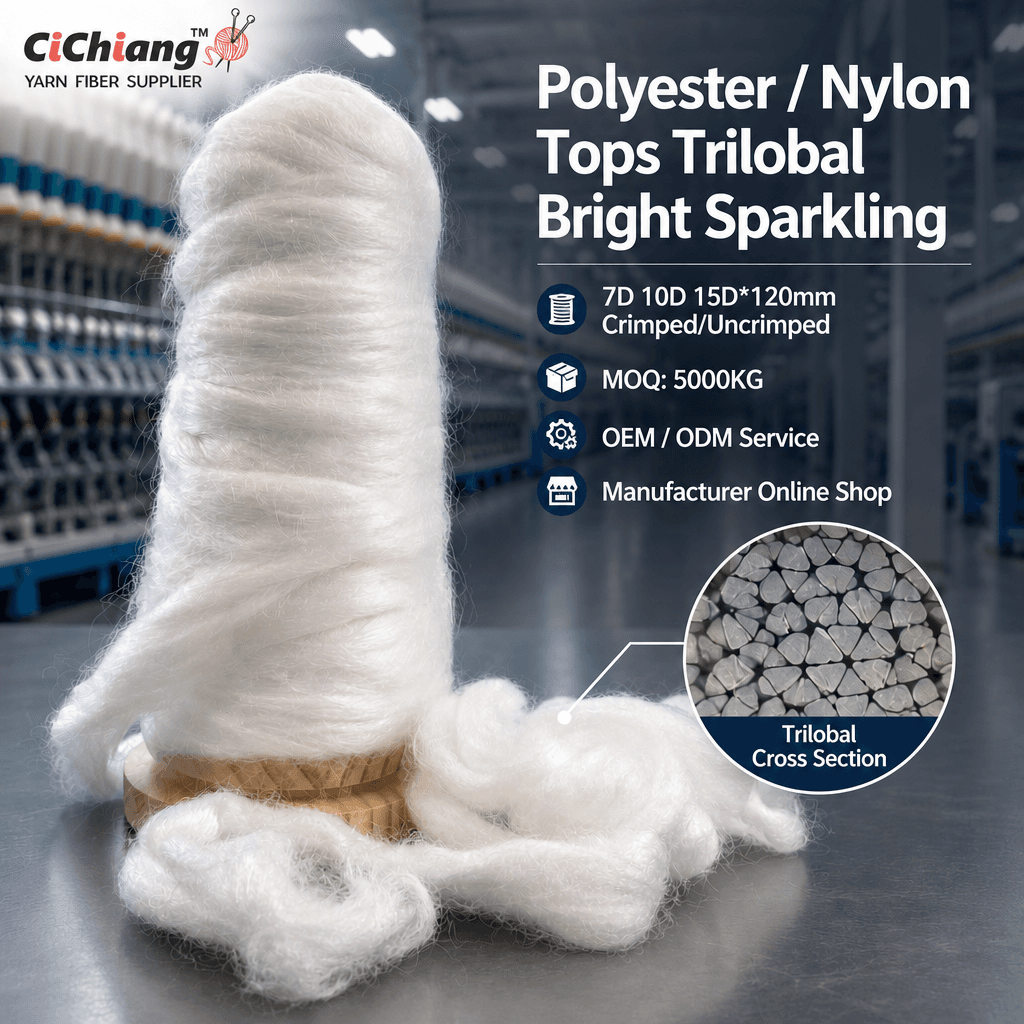
For spinning mills engineering high-luster carpet yarns, decorative upholstery, or specialty apparel blends, standard round-profile fibers often fall flat. Specifying nylon trilobal bright fiber tops introduces a distinct optical dynamic: the three-lobed fiber cross-section acts as a prism, reflecting light directly off clean planar facets rather than scattering it diffusely. But sourcing these combed tops involves balancing optical brilliance against mechanical realities in the drafting zone. Getting the luster you want without sacrificing yarn yield or creating roller lapping requires a clear grasp of cross-section geometry, polymer grade selection, and finish chemistry.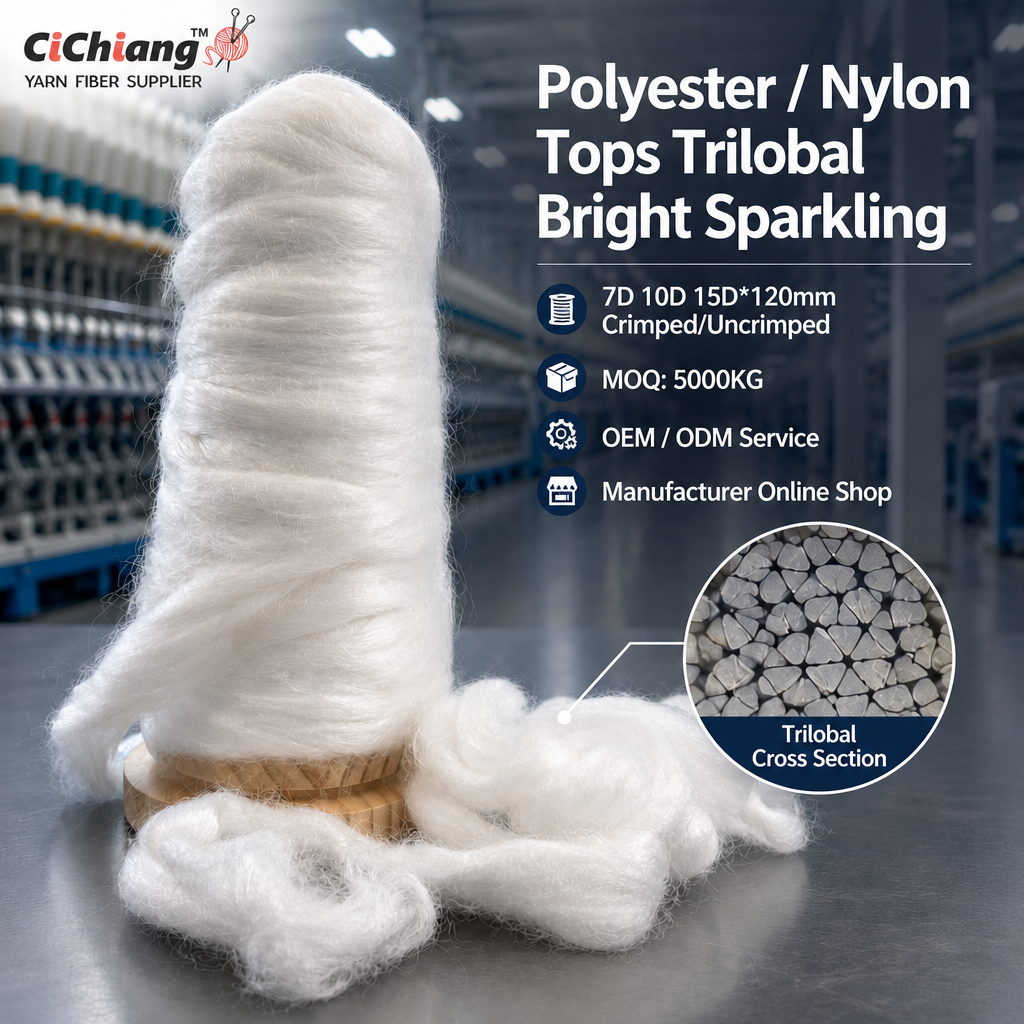
The Mechanics of Luster: How Trilobal Geometry Dictates Optics
Conventional round fibers scatter incident light in multiple directions, yielding a milky, matte, or at best semi-dull appearance even when free of titanium dioxide (TiO2) delustrants. By contrast, a trilobal cross-section nylon fiber is produced using specialized Y-shaped spinneret capillaries. The resulting three lobes provide flat longitudinal surfaces that generate specular reflection—the same mechanism that gives natural silk its flash.
In the trade, fiber producers measure this geometry through the "modification ratio" (MR), defined as the ratio of the outer circumscribed circle diameter to the inner inscribed circle diameter. A higher modification ratio delivers sharp light refraction, intense color clarity, and superior soil-hiding capabilities (critical in commercial floor coverings). However, aggressive lobe profiles also increase fiber-to-fiber friction and make the tips vulnerable to fibrillation or crushing during aggressive combing and gilling operations.
Material Showdown: Polyamide vs. Polyester Trilobal Tops
Mill engineers frequently weigh whether to run nylon or polyester when formulating bright, reflective yarns. While polyester trilobal bright fiber tops (and cut PET staples) dominate budget-sensitive segments, nylon tops provide mechanical resilience that polyester struggles to match in high-fatigue environments.
- Elastic Recovery and Crush Resistance: Polyamide (PA6 and PA66) possesses an inherent molecular springiness. In cut-pile carpets and high-traffic upholstery, trilobal bright nylon tops spring back after compression, keeping the reflective facets oriented uniformly. Conversely, trilobal bright polyester tops tend to crush under load, causing "traffic shading" where flattened lobes scatter light unevenly.
- Dye Absorption and Depth of Shade: Nylon accepts acid and pre-metallized dyes under atmospheric boiling, yielding intense, deep tones with brilliant surface sparkle. Polyester requires high-temperature carrier or pressure dyeing, which can occasionally dull the lobe tips if thermal control drifts.
- Abrasion and Fibrillation: Under repetitive friction, bright trilobal synthetic fiber with brittle polymer chains can snap at the lobe tips. Nylon's superior elongation-at-break shields the cross-section from micro-pilling and surface fuzzing.
Spinning Dynamics: Managing Trilobal Tops in Worsted and Semi-Worsted Lines
Drafting and spinning trilobal bright fiber for spinning into uniform sliver requires subtle machine adjustments compared to standard round tow or staple. Because trilobal fibers have roughly 10% to 15% more surface area per unit mass than round filaments of equivalent denier, their boundary friction and electrostatic tendencies are amplified.
First, monitor the spin finish. An over-application of antistatic oil to control charge buildup will cause gummy drafting rollers and fiber accumulation. An under-application leaves the fiber prone to ballooning and static fly. Sourcing tops with a tightly controlled, uniform oil pick-up (OPU)—typically balanced between 0.5% and 0.8% depending on the ambient humidity of the spinning shed—prevents premature roller lapping.
Second, inspect crimp retention. Because trilobal nylon staple fiber possesses three pronounced lobes, mechanical crimping introduces localized stresses along the lobe vertices. If crimp frequency is too tight or crimp amplitude is over-set, fibers will interlock excessively during drafting, causing uneven thick-and-thin segments in the roving.
Sourcing and Evaluation Checklist for Procurement Teams
When evaluating a potential nylon fiber tops supplier, reviewing baseline denier and cut length is only the starting point. Sourcing teams should insist on tighter technical parameters:
- Polymer Base (PA6 vs. PA66): PA6 tops offer softer hand-feel, easier low-temperature dye strike, and higher economic value for blended apparel and residential rugs. PA66 tops provide a higher melting point, superior thermal stability, and maximum dimensional resilience for automotive and heavy contract upholstery.
- Luster Clarity: Confirm the top is optical bright (typically zero added TiO2, often referred to as super-bright) and clean of insoluble gel particles that could disrupt the specular reflection.
- Nep Count and Vegetable Matter: Tops must be rigorously combed to eliminate short-fiber content and fused neps that scatter light randomly, which appears as cloudy spots in dyed fabric.
- Sliver Weight and Packaging: Standard bumped tops should have uniform linear density (e.g., 10 to 20 g/m) and be wrapped securely to prevent moisture variation during sea freight.
Manufacturing Capacity: Ningbo Sinopec Fiber Co., Ltd.
Established in 1996, Ningbo Sinopec Fiber Co., Ltd. has anchored its operations around commercial-scale polyamide fiber production. Operating from a 50,000-square-meter facility with 20,000 square meters dedicated to clean production space, the company houses 150 skilled staff, including a dedicated core of 20 textile and polymer engineers.
With an established daily output ranging between 100 and 150 tons, the facility processes both PA6 and PA66 polymers. This infrastructure allows for high batch-to-batch consistency in staple fibers and processed tops, addressing the core friction, antistatic finish, and cross-sectional precision required by domestic and export spinning mills.
Frequently Asked Questions
Can nylon trilobal bright fiber tops be blended directly with natural wool?
Yes. They are commonly blended with fine wool (ranging from 20% to 50% nylon content) in semi-worsted spinning for luxury carpets and suitings. The nylon adds tensile strength and light flash, while the wool adds bulk and moisture buffering. Ensure drafting gauge settings match the longest fiber cut length in the blend.
Why does our dyed yarn show uneven shiny streaks ("flashes")?
Streaks generally stem from one of two issues: variation in the modification ratio during melt extrusion, or localized thermal stretching during tow drawing. When lobes are distorted unevenly, individual fiber segments reflect light at differing angles, creating optical banding in flat-woven or tufted goods.
How does moisture regain impact trilobal nylon during processing?
Polyamide is hygroscopic, with standard moisture regain around 4.5% for PA6.6 and 4.0% to 4.5% for PA6. If tops are stored in dry conditions (below 50% RH), static generation skyrockets. Tops should acclimatize on the mill floor for at least 24 to 48 hours at 60–65% RH prior to opening.
Next Steps for Development
Specifying custom modification ratios, deniers, or specialized finishes requires direct trial coordination. Contact the engineering team at Ningbo Sinopec Fiber Co., Ltd. to review fiber specification sheets, discuss PA6/PA66 baseline preferences, or request production-grade sample bumps for spinning trials.