Why core-sheath compound fiber keeps showing up in buyer conversations
A core-sheath compound fiber is one of those materials that looks simple at first glance and then starts causing useful questions the moment a sourcing team gets closer to the application. For nonwoven converters, textile mills, and product teams working on fill, padding, filtration, or insulation, the attraction is easy to understand: a bicomponent structure can give a fiber a more controlled balance of handle, crimp, and processing behavior than a single-material staple fiber. That matters when the end product has to keep its shape, process cleanly, and still feel consistent in the hand.
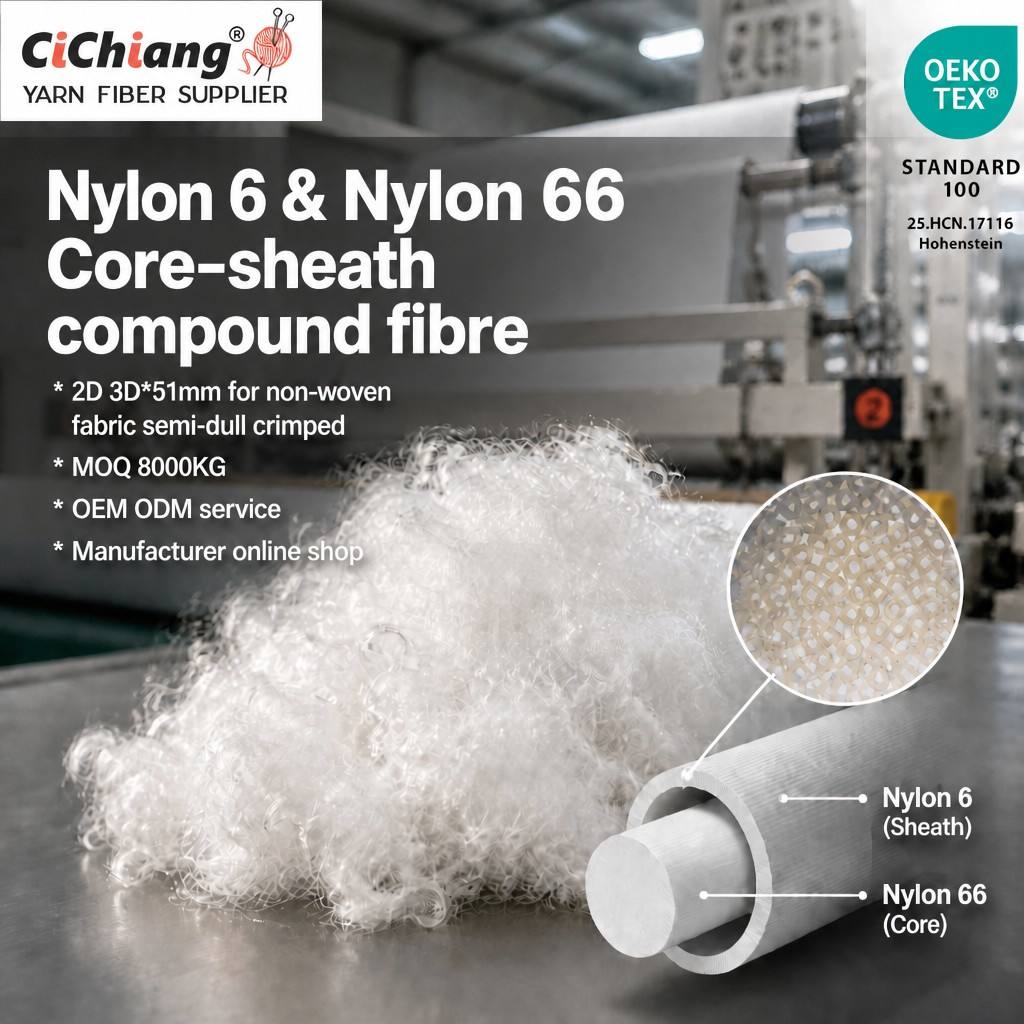
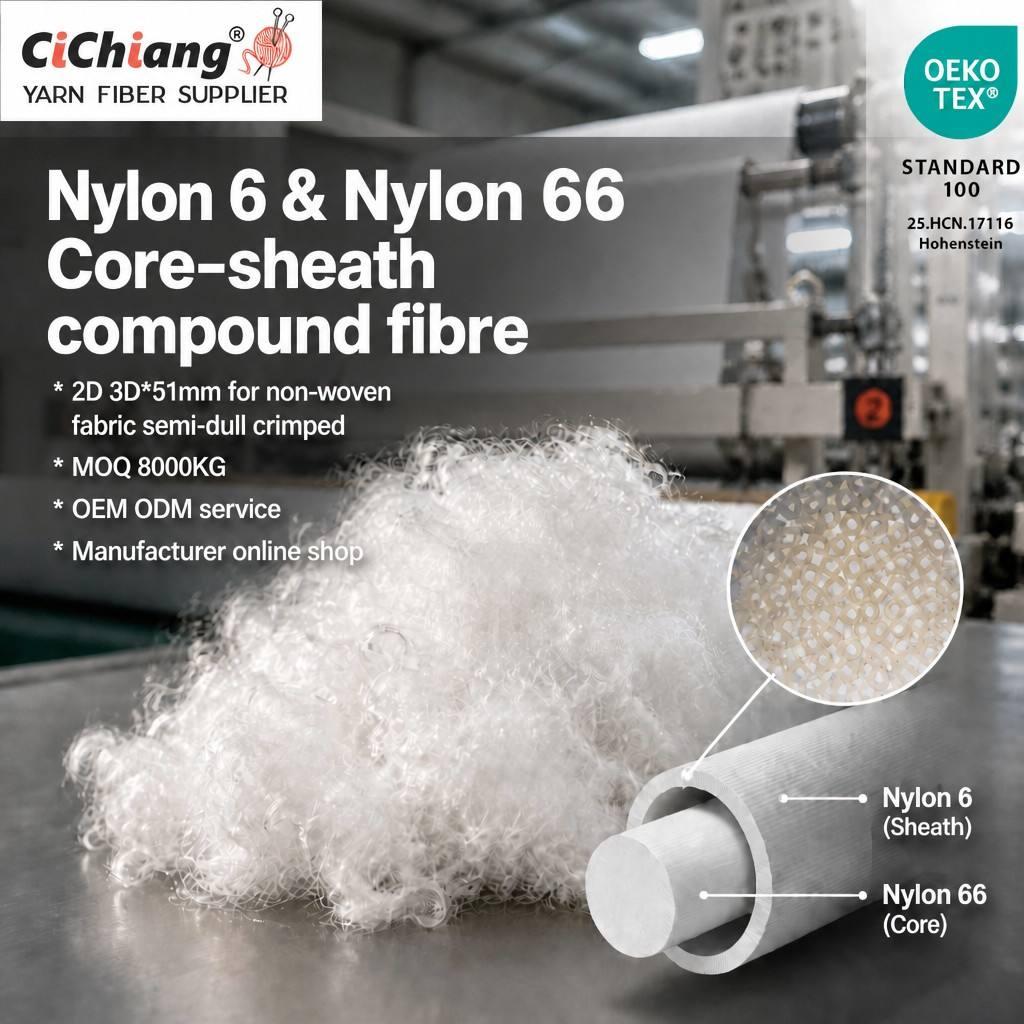
The product information here points to a Nylon 6 and Nylon 66 core-sheath compound fiber, with Nylon 6 as the sheath and Nylon 66 as the core. That is a practical combination, not just a catalog description. Buyers looking at a nylon core-sheath fiber are usually trying to solve a few questions at once: how to get a workable staple fiber for nonwoven fabric, how to keep supply stable, and how to match the fiber form to the downstream line without overcomplicating the bill of materials.
What the visible product details suggest
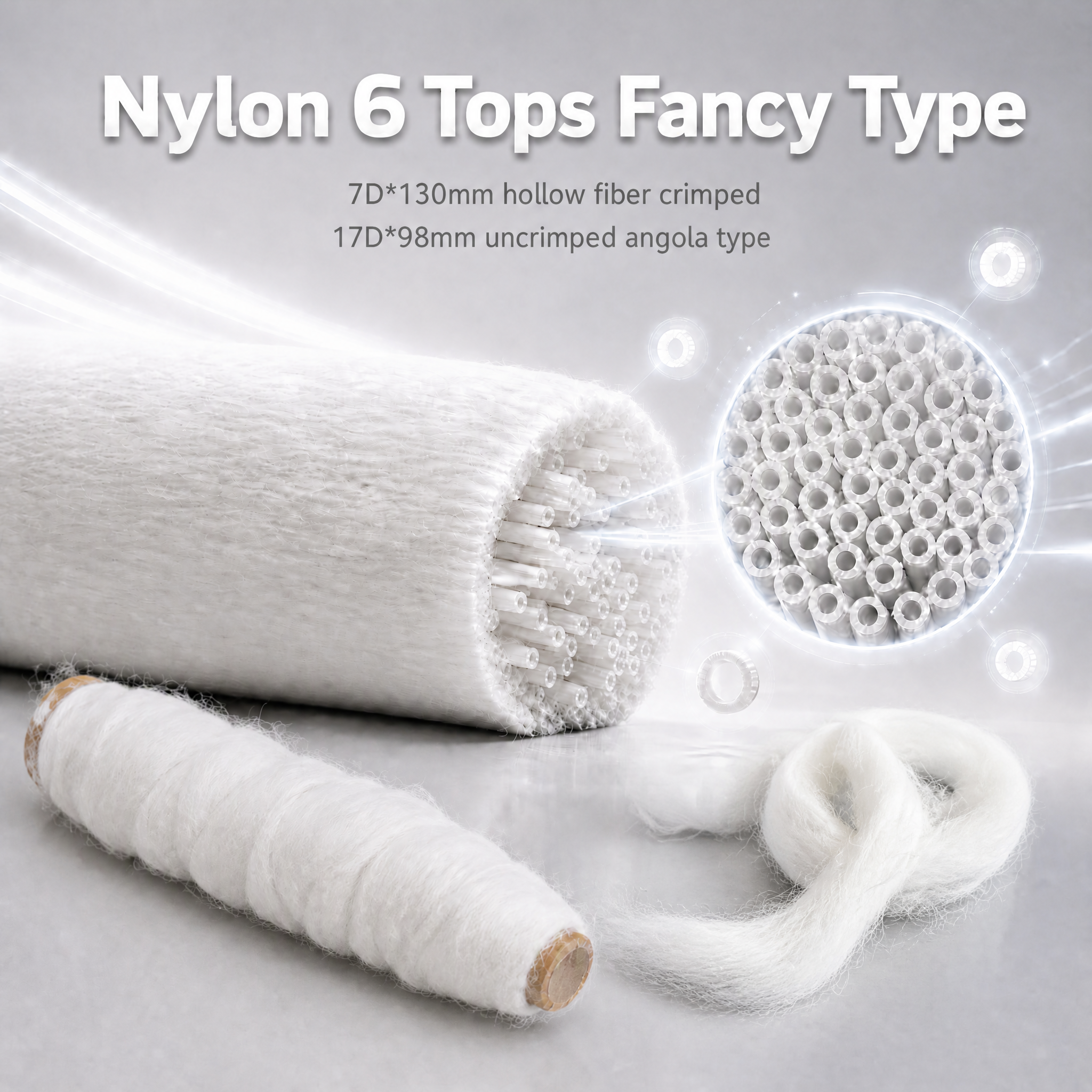
The available information describes a loose white crimped staple fiber in a semi-dull finish, with a round cross-section shown in the inset diagram. The listed forms mention 2D, 3D, and a 51 mm length for non-woven fabric use. That puts this product firmly in the category of synthetic staple fiber and fiber-fill material rather than a specialty monofilament or a highly engineered technical yarn.
For buyers, the shape matters as much as the chemistry. Crimped fiber tufts tend to open well, trap air, and create bulk in fill or padding applications. The semi-dull appearance is also worth noting because it usually signals a more subdued, less glossy look, which can be helpful in products where surface appearance is visible or where a softer visual impression is preferred.
One practical caveat: the product sheet shows a bicomponent nylon structure, but it does not verify every processing detail. So it is safer to treat the visible information as a useful buying clue, not a full technical dossier.
Why Nylon 6 and Nylon 66 in one compound fiber?
In broad terms, Nylon 6 and Nylon 66 are both polyamide fiber families, but they are often selected for different processing and performance reasons. A Nylon 6 sheath over a Nylon 66 core suggests a design that is trying to combine surface behavior with internal support. In the market, that kind of compound fiber can be used where a buyer wants the practical advantages of a nylon composite fiber without moving into a more expensive or specialized construction than necessary.
For nonwoven and textile users, the point is rarely chemical theory alone. The real question is whether the structure helps the line run more predictably, whether the fiber opens and entangles as expected, and whether the final web or fill keeps a clean, even character. Those are the things that show up in production meetings, not in brochures.
Where this fiber fits in manufacturing
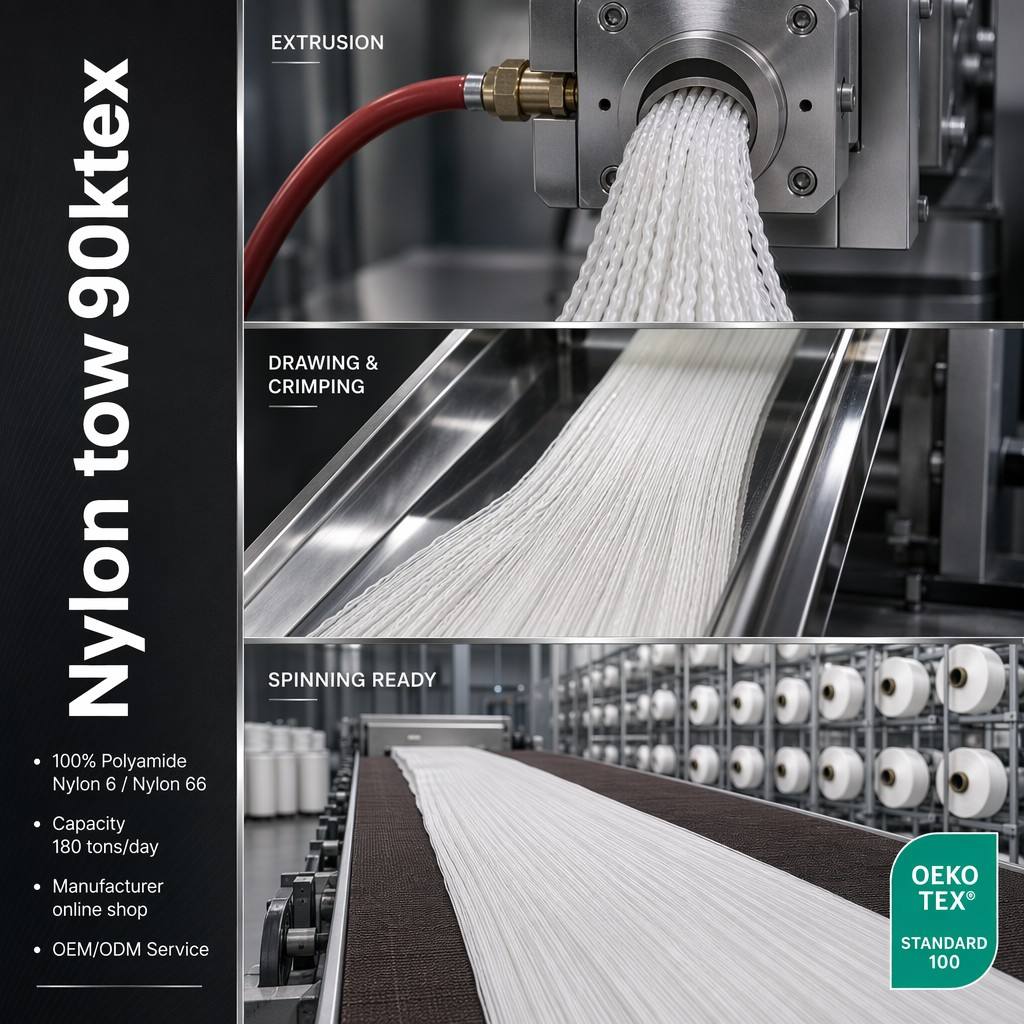
Based on the supplied information, the likely route is a bicomponent melt-spun or composite staple fiber production process followed by crimping and cut-length processing. That is a common path for synthetic staple fiber used in nonwoven fabric, stuffing, padding, filtration, and insulation. I would not overstate the process details beyond that, because the image alone does not confirm the exact line setup.
From a buyer’s angle, the question is not only “what is it?” but “what can it do on my equipment?” A crimped polyamide fiber can behave differently from a flat, smooth staple, especially in opening, web formation, and loft recovery. If the application is stuffing or fiberfill, bulk and resilience matter. If it is filtration, consistency and web structure can matter more than surface feel. The same material can be useful in both cases, but the decision criteria are not identical.
Key buying criteria that should not be skipped
Check the fiber form against the end use
The visible 2D and 3D notes suggest fine-denier options, while 51 mm points to a staple length suited to common nonwoven and textile routes. Buyers should confirm whether the supplied form matches the intended opening and carding equipment. Even a promising material can be awkward if the line was tuned around a different cut length or crimp profile.
Ask for clarification on actual supply format
The information provided does not fully confirm whether the product is sold as raw fiber, cut staple, or finished batting. That is a small detail on paper and a major detail in procurement. Packaging, handling, and conversion cost all change depending on the format.
Do not treat OEKO-TEX as the whole story
The OEKO-TEX Standard 100 label shown in the product information is a useful market signal, especially for textile-facing buyers. Still, responsible sourcing teams usually ask for the current certificate scope and the exact product coverage, rather than assuming every future lot is automatically identical.
Common mistakes when sourcing compound fiber
One frequent mistake is buying on polymer name alone. Nylon 6 fiber and Nylon 66 fiber both sit under the polyamide family, but the downstream feel and processing behavior can still differ. Another common miss is ignoring crimp and bulk until the pilot run. By then, it is often too late to avoid rework.
A second mistake is underestimating the minimum order quantity. Here the listed MOQ is 8000 KG, which is perfectly normal for industrial fiber supply, but it is not a casual sample quantity. Buyers planning small development runs should ask early whether the supplier can support trial lots or staged orders through OEM/ODM service.
What Ningbo Sinopec Fiber Co., Ltd. adds to the picture
Ningbo Sinopec Fiber Co., Ltd. was founded in 1996 and specializes in nylon fiber manufacturing. The company information describes 150 employees, including 20 engineers, with a 50,000 square meter factory and 20,000 square meters of production space. It also states a daily output of 100–150 tons, mainly producing PA6 and PA66 polyamide nylon fibers.
That background matters because compound fiber supply is often judged on consistency as much as on the sample itself. A supplier with long-term nylon manufacturing experience and a visible engineering team is often in a better position to support repeatable lot control, though buyers should still verify the exact product specification for their own application.
Practical next step for engineers and sourcing teams
If you are comparing a core-sheath compound fiber against a conventional polyamide fiber for nonwoven or fill applications, start with three questions: does the crimp match your process, does the length fit your equipment, and does the supply format fit your production plan? Once those are clear, the rest of the decision becomes much easier.
For projects that need a Nylon 6 sheath and Nylon 66 core structure, the safest move is to request a sample confirmation, ask for the current quality documents, and discuss OEM/ODM needs before the trial run. Small details in staple fiber sourcing tend to become large details on the production floor.