Core spun yarn: what buyers are really comparing
When sourcing core spun yarn, most buyers are not just comparing color cards or count labels. They are trying to decide whether a yarn will behave predictably in knitting, weaving, or garment production, and whether it will hold up once it leaves the sample stage. That matters because a yarn that looks fine on a cone can still create trouble downstream: uneven feeding, poor fabric balance, or performance that drifts after washing. In other words, the buying decision is not only about price. It is about process stability.
Ningbo Sinopec Fiber Co., Ltd., founded in 1996, works in nylon fiber manufacturing and says its factory covers 50,000 square meters, with 20,000 square meters of production space, 150 employees, and 20 engineers. The company also notes a daily output of 100-150 tons and a focus on PA6 and PA66 polyamide nylon fibers. For sourcing teams, that kind of background is useful because it suggests the supplier is built for repeat production rather than one-off runs. Still, the yarn itself should be evaluated on its own specification, not on the factory story alone.
What the supplied yarn is telling you
The product notes point to a blended yarn with a stated composition of 50% viscose, 28% nylon, and 22% PBT. That blend is worth attention because each fiber brings a different behavior to the table. Viscose can contribute a softer hand and better drape. Nylon generally supports strength and abrasion resistance. PBT is often chosen where resilience and stretch recovery matter. The exact core/sheath arrangement is not visible here, so it would be a mistake to assume the internal structure without confirmation from the supplier.
The listed counts, 28S/2 and 48Nm/2, also indicate that this is a two-ply yarn. That is relevant for fabric developers because ply structure can affect bulk, balance, and how the yarn behaves on knitting or weaving equipment. Buyers often miss this detail when they focus only on the color or composition. Later, they discover that the handfeel is right but the machine performance is not.
Where this kind of yarn fits in production
In practice, core spun yarn is used wherever a manufacturer wants a combination of comfort and technical performance. Apparel fabric, knitwear, socks, underwear, and woven textiles are all plausible end uses for this type of yarn, provided the downstream testing supports the application. The supplied notes also mention core spun yarn for knitting and core spun yarn for weaving, which aligns with how mills usually buy this category: as an input material that must work cleanly on a specific machine setup.
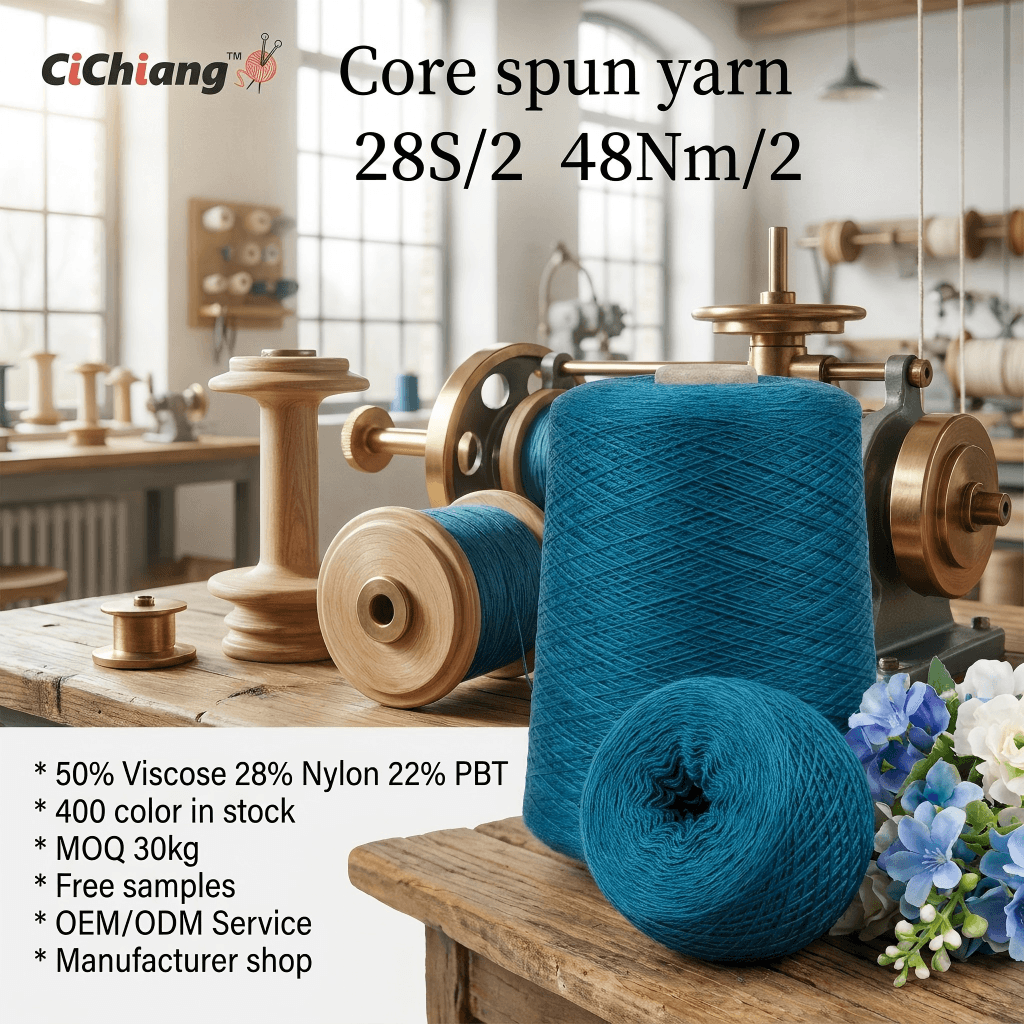
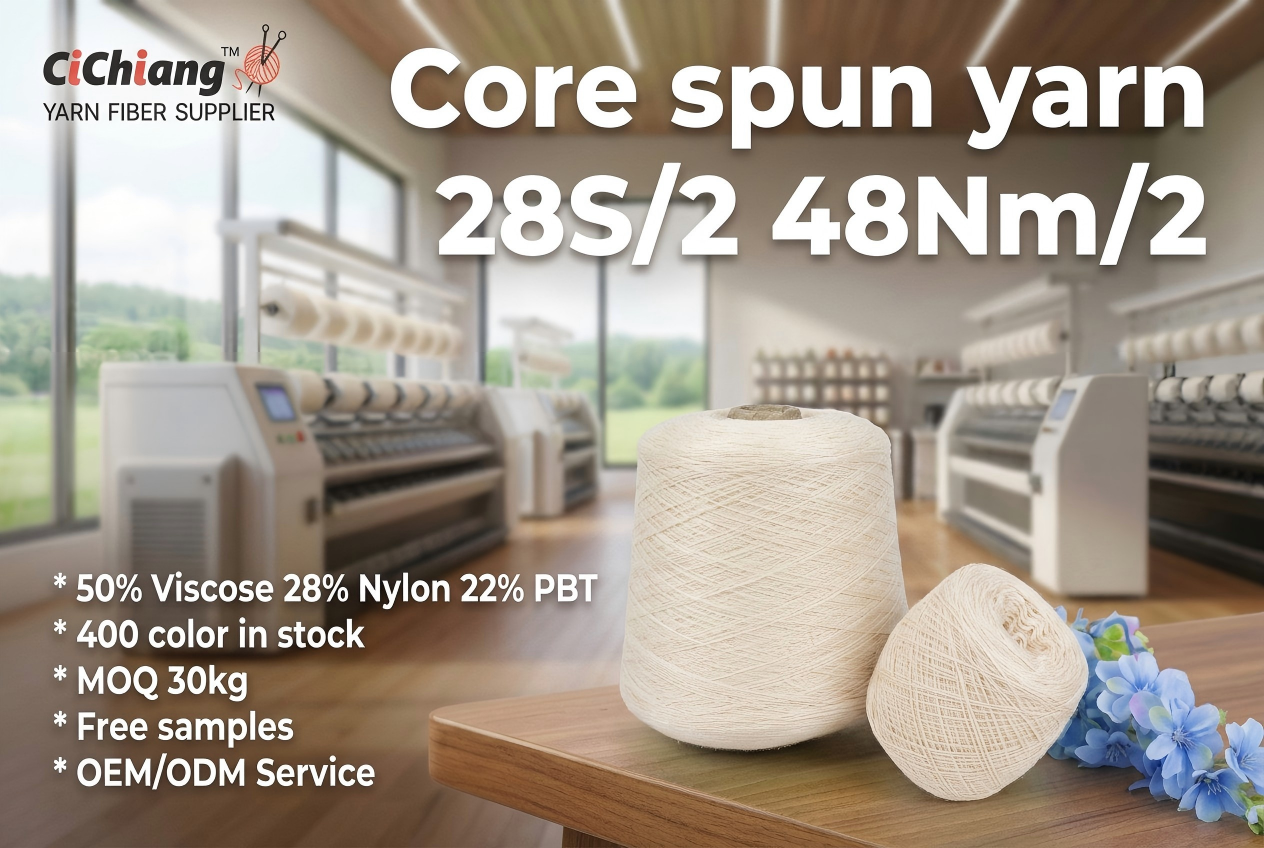
The image and notes also suggest an OEM/ODM service model, along with 400 colors in stock, free samples, and a 30 kg MOQ. Those are not just sales bullet points. They matter to buyers who need to move fast between development rounds, especially when matching a shade for a seasonal program or testing a small production lot before committing to bulk.
How to judge a yarn supplier without overcomplicating the process
If you are shortlisting a core spun yarn manufacturer or core spun yarn supplier, the first question is whether the yarn matches your process constraints. Ask how it will feed, whether the count is stable across lots, and whether the shade range can be repeated. Color consistency is not glamorous, but in garment production it can save a lot of argument later.
For mills buying core spun yarn wholesale, the commercial checks should sit beside the technical ones. MOQ, sample policy, and custom color availability can matter just as much as raw fiber content. A supplier may offer an attractive specification on paper, but if the ordering structure does not fit your production calendar, the yarn is not really suitable.
Practical cautions buyers should not ignore
Do not assume the visible finish tells you the whole story. A smooth cone-wound package can still hide issues such as inconsistent twist, unclear shrinkage behavior, or poor lot-to-lot shade control. Also, if you are comparing polyester core spun yarn or cotton core spun yarn against a viscose/nylon/PBT blend, remember that the handfeel and machine behavior may differ in ways that are not obvious from a catalog photo.
One more practical point: if the yarn will be used in fine-gauge knitting or tightly specified weaving, request the exact count interpretation and confirm the number system. 28S/2 and 48Nm/2 are useful references, but they should be verified rather than assumed to mean the same thing across every purchasing team or production system.
Why the supplier’s manufacturing base matters
Ningbo Sinopec Fiber Co., Ltd. presents itself as a nylon-focused manufacturer with scale, engineering support, and long-term partnership ambitions. For sourcing managers, that combination can be helpful when a project moves from sampling into steady supply. It is especially relevant if you need a consistent yarn program rather than an occasional spot buy.
That said, the safest buying approach is still the old one: evaluate the sample, confirm the spec sheet, and test the yarn in your own process. Buyers in textile manufacturing know that the most expensive problem is not the sample that looks a little different. It is the lot that behaves differently once the machine is already running.
What to ask before placing an order
If you are moving toward a trial, ask for the composition confirmation, count interpretation, color standard, sample availability, and the MOQ for the color you actually need. If the yarn is for knitwear, ask how it performs on your intended gauge. If it is for weaving, ask about feeding consistency and any process notes the supplier can provide. Those questions are simple, but they separate a practical supplier from a merely attractive listing.
For teams looking for core spun yarn for knitting or core spun yarn for weaving, the next step is straightforward: request samples, verify the count and blend, and check whether the supplier can repeat the same shade and structure in the quantity your line needs. In textile buying, that is usually where the real decision gets made.