Why core spun yarn matters when fabric performance is on the line
For mills and product teams, core spun yarn is often the point where a fabric either gets enough strength and recovery to survive real wear, or ends up looking good on the cone and disappointing after a few wash cycles. The appeal is straightforward: a core-spun structure is designed to combine surface hand feel with the performance of a stronger inner element, which is why it keeps showing up in knitting, weaving, sweaters, hosiery, and fashion textiles.
That basic idea sounds simple, but sourcing it rarely is. Buyers have to decide whether they need a yarn for knitting or weaving, whether the blend suits the final fabric, and whether the supplier can hold color, count, and winding consistency across orders. Small changes in the yarn make a large difference downstream. A garment developer may care about drape and softness first, while a production manager worries about feeding stability and package quality. Both are right.
What the supplied product details actually tell buyers
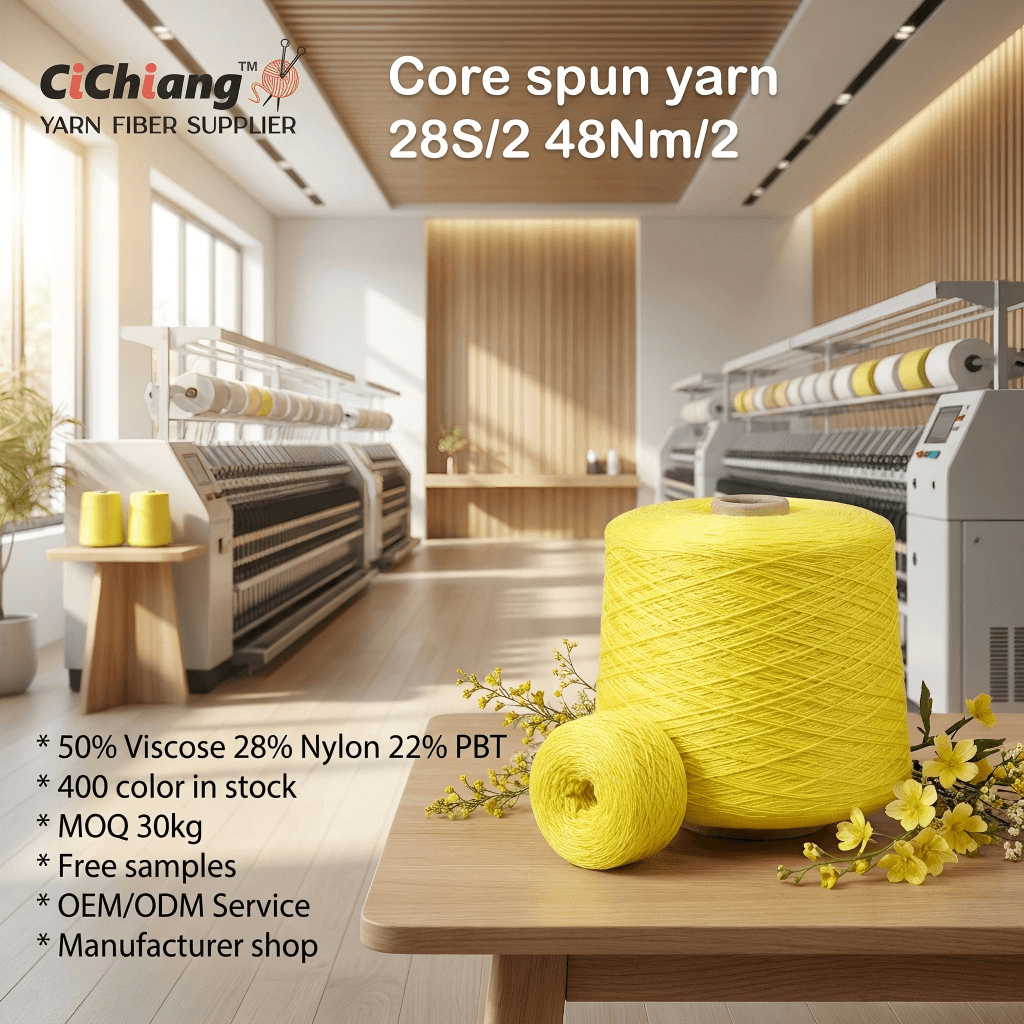
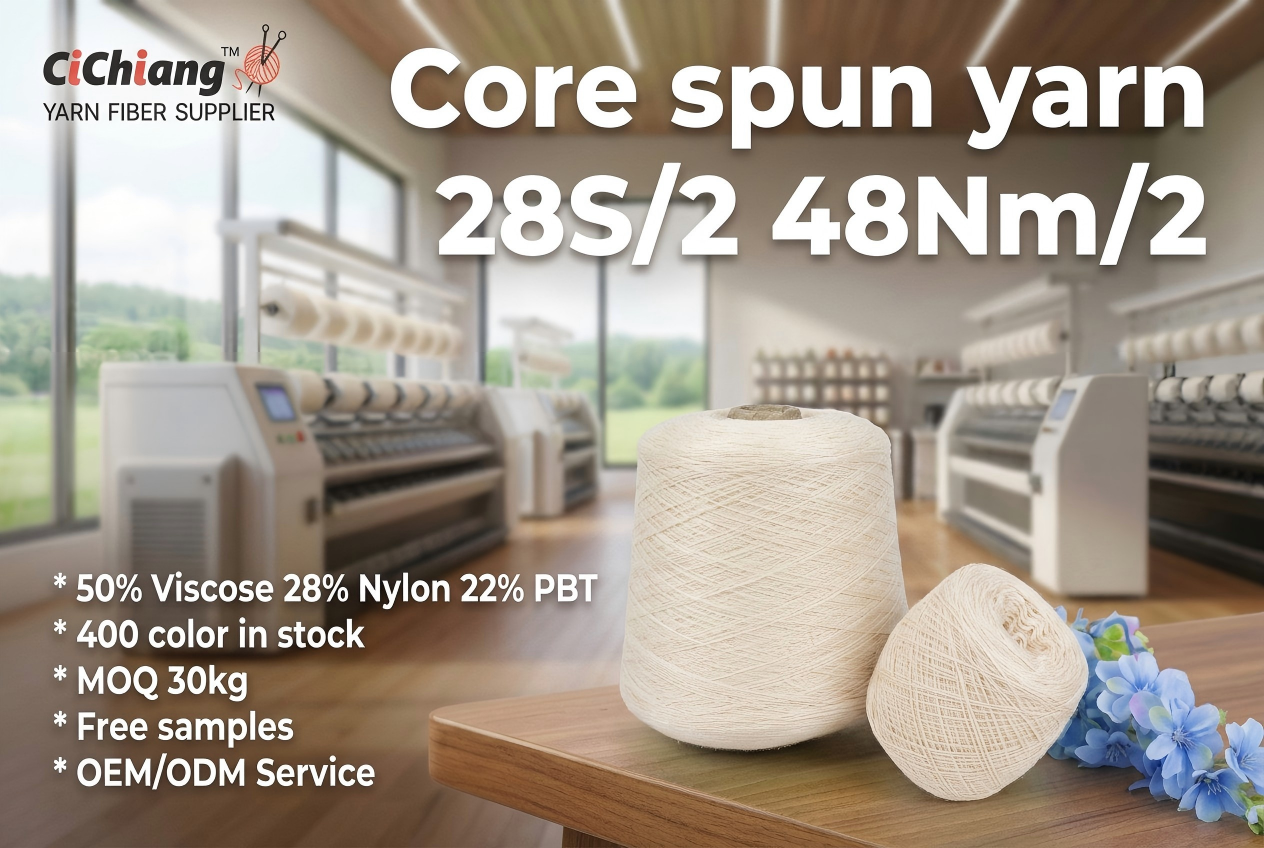
The provided material description points to a blended yarn with 50% viscose, 28% nylon, and 22% PBT, shown in creamy white and also in a bright lime-green sample. That composition suggests a yarn aimed at balancing softness, resilience, and a more technical feel than a plain staple yarn. The visible package form is a cone or spool, which is the format most mills want for industrial feeding.
The count references shown in the image are 28S/2 and 48Nm/2. Those may indicate different specification references or separate options, but the exact interpretation should be confirmed with the supplier before any bulk purchase. That is not a minor detail. Count and ply influence fabric appearance, machine behavior, and final weight. If a buyer treats two similar-looking yarns as interchangeable, trouble usually appears later at the knitting or weaving stage.
The supplier statements also mention 400 colors in stock, MOQ 30 kg, free samples, and OEM/ODM service. Those are useful signals for development work and small runs, especially when a brand wants to test a new shade or knit structure before placing a larger order.
Core spun yarn in practical use: where it earns its place
In textile production, a core spun yarn is valued when the fabric needs more than a soft surface. Knitwear developers often look for improved stability in cuffs, collars, rib structures, and body yarns. Weaving mills may want a yarn that helps support cleaner fabric formation while still offering a more appealing surface than a purely technical filament. The exact benefit depends on the hidden construction, which is why samples matter more than sales language.
For a buyer comparing core spun yarn for knitting against core spun yarn for weaving, the first question is not color. It is process fit. Will the yarn run smoothly through the intended machine? Does it keep its package shape during feeding? Does it produce the right texture after finishing? A yarn can look perfect on a shelf and still behave awkwardly in production. That is the sort of problem that shows up after the purchase order is signed.
How this differs from polyester or cotton core spun yarn
Searches often narrow to polyester core spun yarn or cotton core spun yarn, but the supplied product data here points to a viscose/nylon/PBT blend rather than either of those common forms. That matters because the surface feel, recovery, and visual character will differ. Polyester core-spun constructions are often chosen for durability and easy-care performance. Cotton core spun yarn is usually selected when buyers want a more natural touch. A viscose-nylon-PBT blend sits somewhere else in the spectrum, with a softer hand than many technical yarns and more engineered behavior than basic fashion yarns.
That does not make one option universally better. It simply means the yarn should be judged against the end product, not against a generic category label. A sweater developer may favor the blend’s drape and color response, while a workwear buyer may want a different fiber balance entirely.
What to ask a core spun yarn manufacturer before ordering
When evaluating a core spun yarn manufacturer or core spun yarn supplier, the useful questions are practical ones. Ask for the exact fiber breakdown, the interpretation of the count, and a sample matched as closely as possible to your intended production route. Ask how the yarn is packed, whether the cones are suitable for your machines, and whether the same shade can be repeated across the next lot.
If you are buying core spun yarn wholesale, request enough sample length to test in the real process, not just in a hand swatch. Lab handling can hide issues that show up only at machine speed. This is especially true with fine yarns and with bright colors, where visual consistency and package build can make or break the line.
About the company behind the supply
Ningbo Sinopec Fiber Co., Ltd., founded in 1996, specializes in nylon fiber manufacturing. The company states that it has 150 employees, including 20 engineers, a 50,000-square-meter factory, and 20,000 square meters of production space. It also reports a daily output of 100 to 150 tons, mainly in PA6 and PA66 polyamide nylon fibers. For sourcing teams, that background suggests a supplier with industrial-scale fiber capability rather than a small trading desk.
Still, capacity and product scope should never be assumed to mean automatic fit for every yarn program. A buyer should verify the exact product being offered, especially when a listing combines multiple yarn references, color options, and service claims in one place.
A few buyer-side cautions worth keeping in mind
Do not assume the visible cone color tells you everything about dyeing behavior. Do not assume the yarn count notation means the same thing across every supplier. And do not skip the sample stage just because the supplier offers low MOQ. Small quantities are helpful, but they do not replace production testing.
If the goal is a knitwear launch, a woven fashion line, or a custom textile development project, the next step is simple: ask for a confirmed spec sheet, a production sample, and a machine-use recommendation tied to your process. That is the fastest way to find out whether the yarn is a good material match or just a visually attractive one.
FAQ: quick questions buyers usually ask
Is this yarn suitable for both knitting and weaving?
It may be, but that depends on the final count, twist, and machine requirements. The supplied details suggest both applications are possible, yet testing is essential.
Can I order small quantities for development?
The supplier information indicates an MOQ of 30 kg and free samples, which is useful for development work. Confirm the sample terms directly.
Is the material a polyester or cotton core spun yarn?
No. Based on the provided data, the listed blend is viscose, nylon, and PBT. That should be treated as the current reference unless the supplier confirms otherwise.
What should I check first before placing an order?
Confirm the exact count, the fiber composition, color match, cone format, and machine suitability. Those four points usually prevent the most expensive surprises.